Share on Facebook
 Share on X
 Share by Email
 Share on Google Classroom
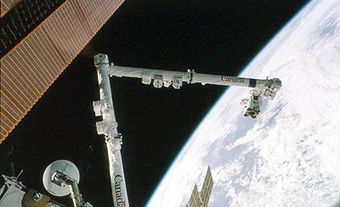
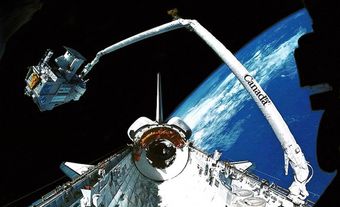
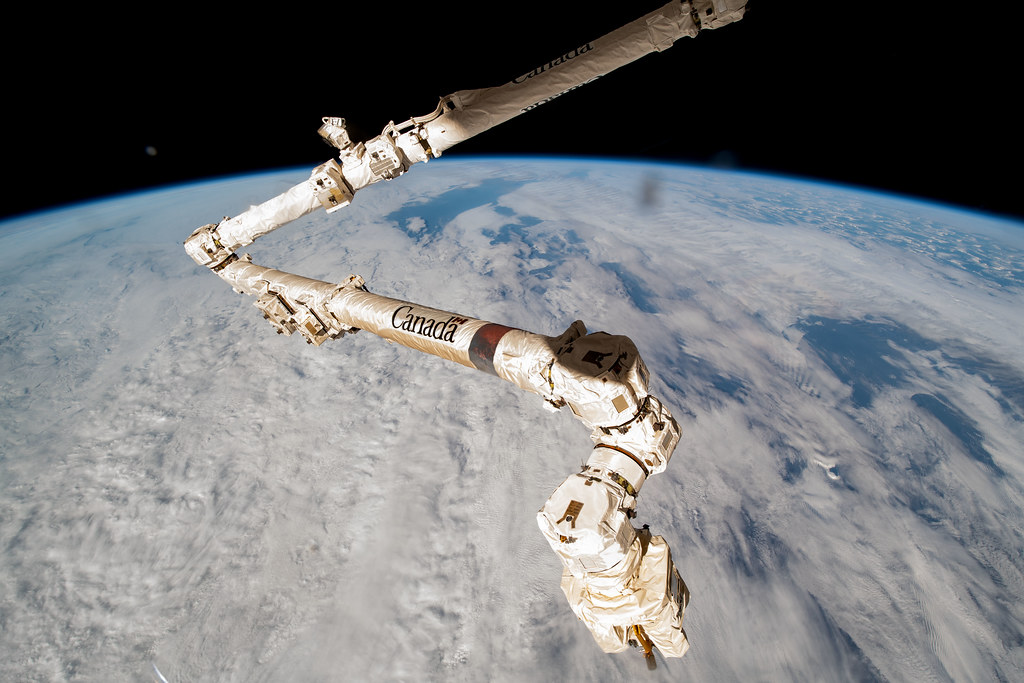
Canadarm2 is a remote-controlled Canadian robotic arm used on the International Space Station (ISS). Canadarm2 was designed as a successor to the robotic Canadarm, which was the mechanical arm used during NASA’s Space Shuttle Program from 1981 to 2011. The design of Canadarm2 is a foundation for creating new generations of robotic arms, including the future Canadarm3. Canadarm2 has reinforced Canada’s global leadership in space robotic systems. (See also Robotics in Canada.)
Development
The $1.4-billion Canadarm2 development was overseen by its industrial prime contractor, Spar Aerospace Limited. (The space division of Spar Aerospace was acquired by MacDonald, Dettwiler and Associates Ltd., now called MDA Space, in 1999.) Canadarm2 is part of Canada’s contribution to the ISS partnership, allowing Canadian Space Agency (CSA) astronauts and Canadian science experiments to fly in space as an exchange.
Canadarm2 was designed, built and tested from 1986 to 2001. While the arm’s design was informed by Canadarm, the newer arm was built to be bigger and more durable, with the ability to manipulate larger payloads in space. Unlike Canadarm, Canadarm2 was also designed to move across the ISS to reach many parts of the station.
After 13 years of development in Brampton, Ontario, Canadarm2 was signed over to the CSA on 12 March 1999. The arm was carefully shipped on 16 May 1999 to the Kennedy Space Center for testing and then integrated on the space shuttle Endeavour for launch.
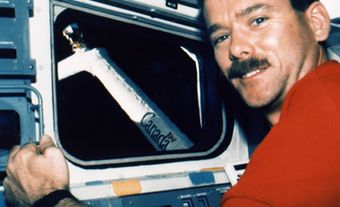
Canadarm2 was launched aboard Endeavour on 19 April 2001 during mission STS-100, which also carried CSA astronaut Chris Hadfield. Hadfield was tasked to help set up Canadarm2 during the first-ever Canadian spacewalk on 22 April 2001.
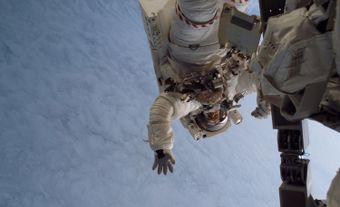
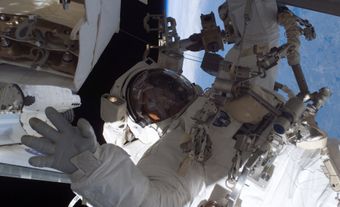
Hadfield and NASA astronaut Scott Parazynski did two spacewalks to get the arm ready, including activities such as unbolting Canadarm2 from its storage pallet, setting up cables, unfolding the arm and attaching one side of Canadarm2 to the Destiny Laboratory Module on the ISS. After installation, Canadarm2 was commanded to transfer its storage pallet to Canadarm on 28 April 2001. Both robotic arms working together became known as the “robotic handshake” or “Canadian handshake.”
Features
Canadarm2 was initially designed to assist with installing modules during construction of the ISS. Today, it is tasked with maintaining the ISS, capturing and berthing cargo ships and moving supplies, equipment, robotics and astronauts.
Canadarm2 is 17 metres long and has a mass of nearly 1,500 kilograms. Much like a human arm, Canadarm2 has seven degrees of freedom: three joints at a shoulder area, one joint at an elbow, and three joints at a wrist. But Canadarm2 has greater freedom of motion, as each joint can rotate 540 degrees (or 270 degrees in each direction).
The robotic arm predecessor, Canadarm, had a “hand” on one side of the arm known as a Latching End Effector. Canadarm2 has two of these devices. These circular effectors have cables inside them for gripping onto the ISS or other objects in space.
To withstand high radiation levels and extreme temperature changes in space, the arm is composed of 19 layers of high-strength carbon fibre thermoplastic. The arm is also made up of removable sections that can be serviced in space using other robotics or spacesuited astronauts.
The robotic arm also has features to help operators. Arm operators can reach many parts of the station, with the Mobile Base System, a work platform that moves along the main truss of the ISS. Operators can also simulate a sense of “touch” through force-moment sensors, which provide automatic collision avoidance. To see around it, Canadarm2 has four colour cameras: two are mounted on either side of the “elbow,” and the remaining on the “hands.”
Role in International Space Station Activities
Canadarm2 forms only one part of the Canadian robotics on the ISS. The two-armed, seven-jointed Dextre arrived at the station in 2008 to install and replace equipment and test technologies, such as fuelling in space. The Mobile Base System, launched to the ISS in 2002, transports astronauts, equipment and other Canadian robotics.
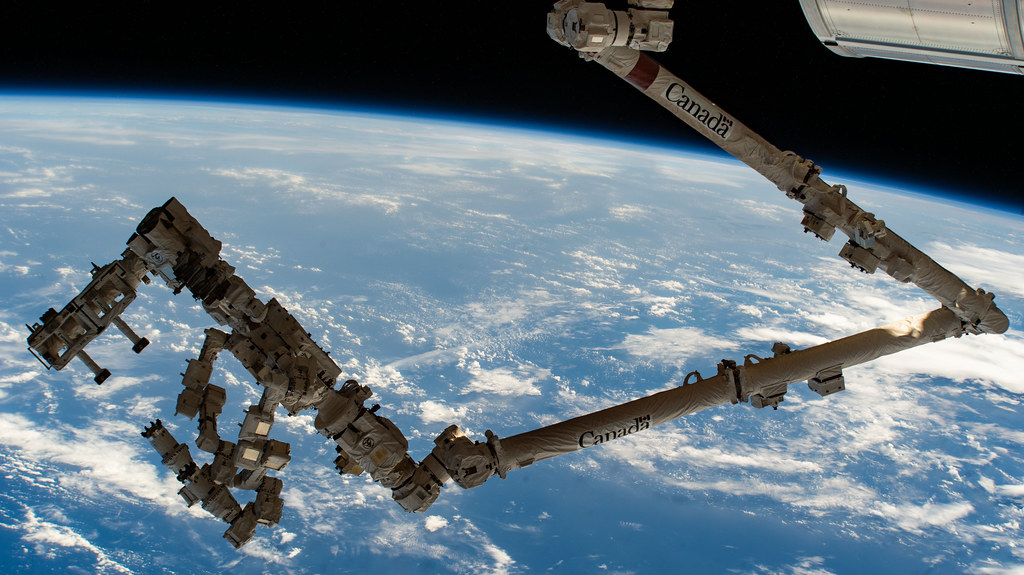
The flexibility of Canadarm2 has allowed the robotic arm to do complex and unexpected tasks. For example, on 3 November 2007, Canadarm2 was used during a spacewalk to help Scott Parazynski repair a solar panel that had torn during deployment. Canadarm2 grappled a long shuttle “boom” — equipment made by MDA Space that was usually used to scan the space shuttle for broken tiles. Parazynski was then attached to the far end of the boom, allowing him to reach the faraway solar panels for the repair.
Canadarm2 is also used to “catch” cargo ships carrying supplies for the ISS, which the robotic arm was not originally designed to do. The first catch was on 17 September 2009 with the Japanese H-II Transfer Vehicle.
Significance of Canadarm2
Canadarm2 extended Canada’s space robotics expertise, with the Government of Canada estimating that 200 Canadian companies contributed to its development. The program allowed Canada to add flight controllers to NASA operations in the early years of the robotic arm’s work, extending Canada’s work in orbit.
Additionally, many Canadian astronauts have operated Canadarm2 in space. Steve MacLean was the first to do so in September 2006. Other Canadian astronauts who operated Canadarm2 have included Chris Hadfield, Julie Payette and Robert Thirsk. NASA astronaut Andrew Feustel, who has dual citizenship in the United States and Canada, was the first Canadian to grapple a visiting cargo ship with Canadarm2 — an event that took place over Quebec on 2 July 2018. A few months later, David Saint-Jacques became the first CSA astronaut to achieve the same feat.
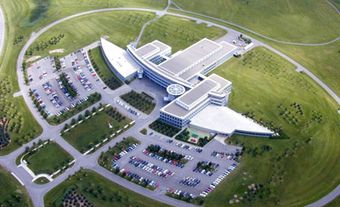
While Canadarm2 and other space robotics were originally controlled in space by astronauts, ground controllers can also do the work. After Canada gained experience, a robotics support room opened at the CSA's headquarters in Longueuil, Quebec, to allow Canadian flight controllers to work on Canadarm2 and space robotics from Canada. Today, CSA’s robotics support room supports more than 100 days of space operations per year. Some robotics operations are also done at the Johnson Space Center in Houston, Texas.
Canadarm2’s legacy has stretched far beyond the ISS. A similar robotic arm system was deployed by Canada on NASA’s Phoenix mission to Mars. Canadarm2 is also informing the design of the next-generation Canadarm3, which is under construction by MDA Space. There have also been medical applications of Canadarm2’s technology, including Synaptive Medical creating the Modus V robotic digital microscope to assist medical professionals during surgery. Canadarm2 is also featured on the Canadian five-dollar bill, alongside Dextre and the Mobile Servicing System.