Share on Facebook
 Share on X
 Share by Email
 Share on Google Classroom
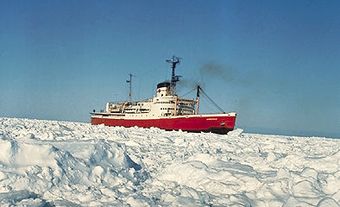
Canada has the second-largest icebreaking fleet in the world; only Russia has more icebreakers. The Canadian Coast Guard’s fleet of heavy, medium and light icebreakers supports commercial shipping, scientific research and Arctic sovereignty.
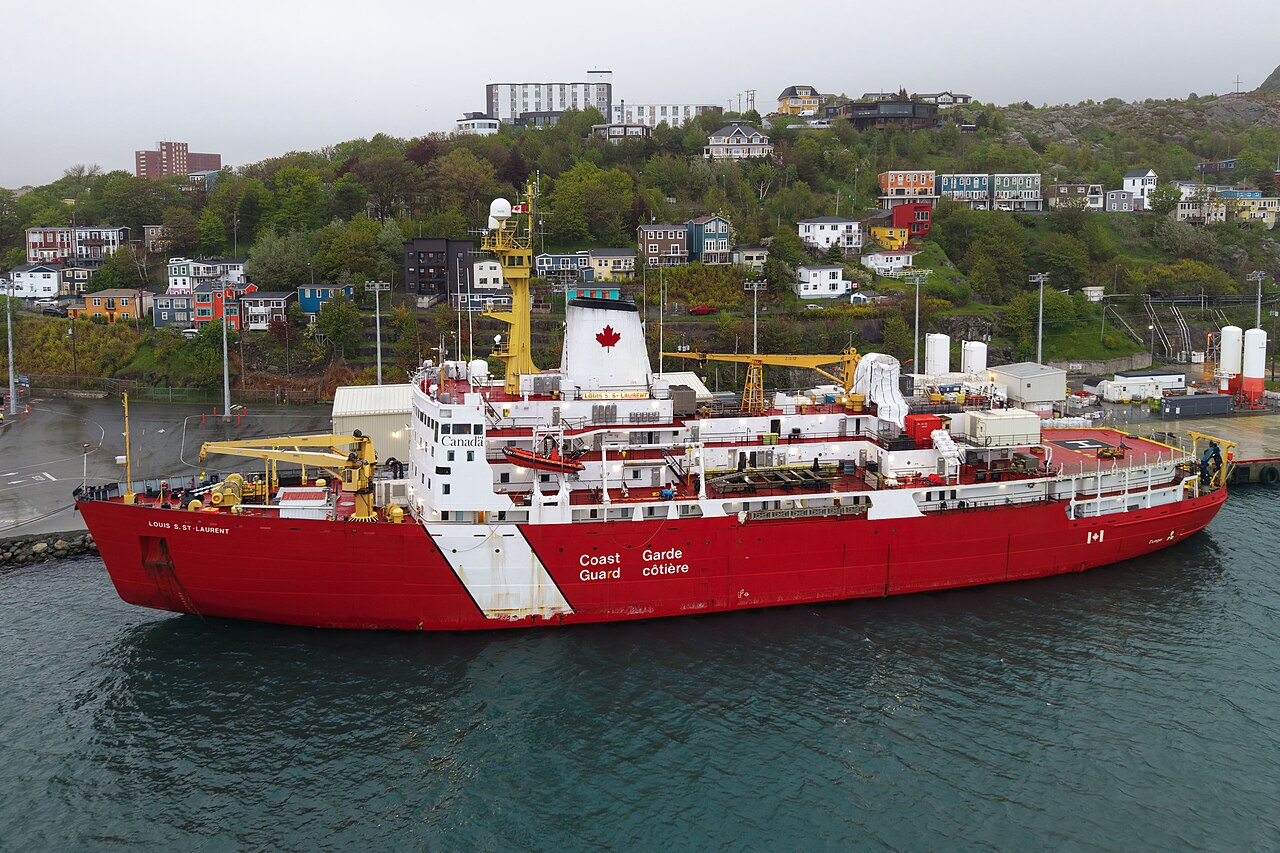
Icebreakers in Canadian Waters
An icebreaker's chief function is to break, separate or divert ice in ice-covered waters. The Canadian Coast Guard (CCG) icebreaker fleet has been designed and built for Canadian needs: to assist shipping in lakes, oceans and river mouths; to keep channels open through the St Lawrence Seaway system; and to support government supply, economic development and sovereignty operations in the Arctic. CCG icebreakers generally operate in southern waters in the winter months and the Arctic during the summer.
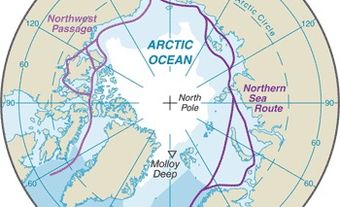
Icebreakers have become increasingly important for Arctic sovereignty and economic development. The melting of Arctic ice has led to more vessel traffic and international competition in the Northwest Passage. Although Canada considers the passage to be internal waters, the US and other countries argue that it is an international strait. Icebreakers allow Canada to patrol and monitor these waters, supporting its claims of Arctic sovereignty. They also extend the navigation season, allowing both the import of supplies and the export of raw materials such as crude oil, natural gas and ores for a greater part of the year.
History of Icebreakers in Canada
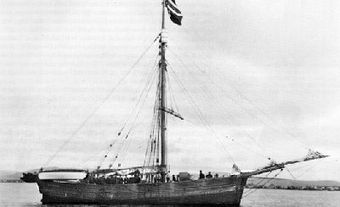
Canada has had icebreakers for most of its history. One of the first was the Chief Justice Robinson, a commercial icebreaking vessel built in 1842 for passenger service between Niagara and Toronto. One of the promises of Confederation — a guaranteed year-round ferry service between Prince Edward Island and the mainland — resulted in the construction of three small icebreaking ferries between 1876 and 1899. At the turn of the 20th century, Canada's first full icebreakers, the Champlain and Montcalm, were built to break up ice barriers and dams that caused annual flooding at narrow points along the St Lawrence River.
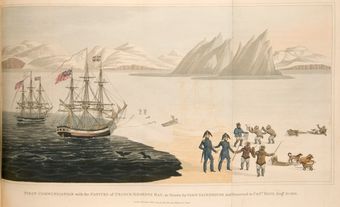
Icebreakers were first used in the Canadian Arctic in the 1920s to deliver supplies and services to Indigenous and isolated settlements during the short summer season, and to back up claims of Canadian sovereignty over the Northwest Passage and Arctic Archipelago. (See also Eastern Arctic Patrol.) In the 1930s, the port of Churchill was opened for grain shipments, and in 1957 the government undertook the annual supply of Distant Early Warning (DEW) line sites across the Arctic.
Commercial icebreakers also operate in the Arctic. The Canmar Kigoriak, for example, was a 7,200 deadweight tonnage (dwt) icebreaker owned by Canadian Marine Drilling Ltd (later Amoco). From 1979 to 1997, it was used to convoy drilling rigs and other kinds of marine units working in Arctic ice. The Kigoriak was the first commercial icebreaker built for offshore oil exploration in the Beaufort Sea. It was basically experimental, the prototype for the gigantic 200,000 dwt icebreaker-tanker of the future.
Icebreakers and the Franklin Search
Canadian icebreakers have played an important role in the search for historic shipwrecks in Arctic waters. In the early 1980s, CCGS Sir John A. Macdonald and Pierre Radisson were involved in the discovery of the shipwreck Breadalbane in Resolute Bay (see also Joseph B. MacInnis). In the 2010s, CCGS Sir Wilfrid Laurier was the key staging ship in the search for HMS Terror and Erebus. (See also Franklin Search).
Scientific Research
Canadian icebreakers have also been involved in Arctic research expeditions. In July and August 1994, for example, the icebreakers CCGS Louis S. St. Laurent and the US Coast Guard Polar Sea carried out the first Canada/USA Joint Scientific Expedition to the Arctic Basin and the North Pole. It involved 70 Canadian and US scientists in about 30 research activities focused on understanding the Arctic region in an era of global climatic change. These included ocean properties of circulation and ice cover as well as atmospheric radiation and the “greenhouse effect.” Though not originally scheduled as part of the expedition, on 22 August 1994, both ships reached the North Pole. They were the first North American surface ships to do so over the long, unexplored sea route from the western end of the Arctic Ocean.
Canada’s icebreakers remain an important part of research expeditions. In August-September 2026, for example, CCGS Louis S. St-Laurent conducted a joint operation with Swedish icebreaker Oden to map the seabed of the Arctic Ocean. The CCG also has a dedicated research vessel. In 2002, CCGS Sir John Franklin (now CCGS Amundsen) was retrofitted as an Arctic research icebreaker, with state-of-the-art research facilities. National and international teams can use portable and onboard laboratories to conduct experiments, while the vessel’s sensors and oceanographic samplers allow researchers to collect and analyze data.
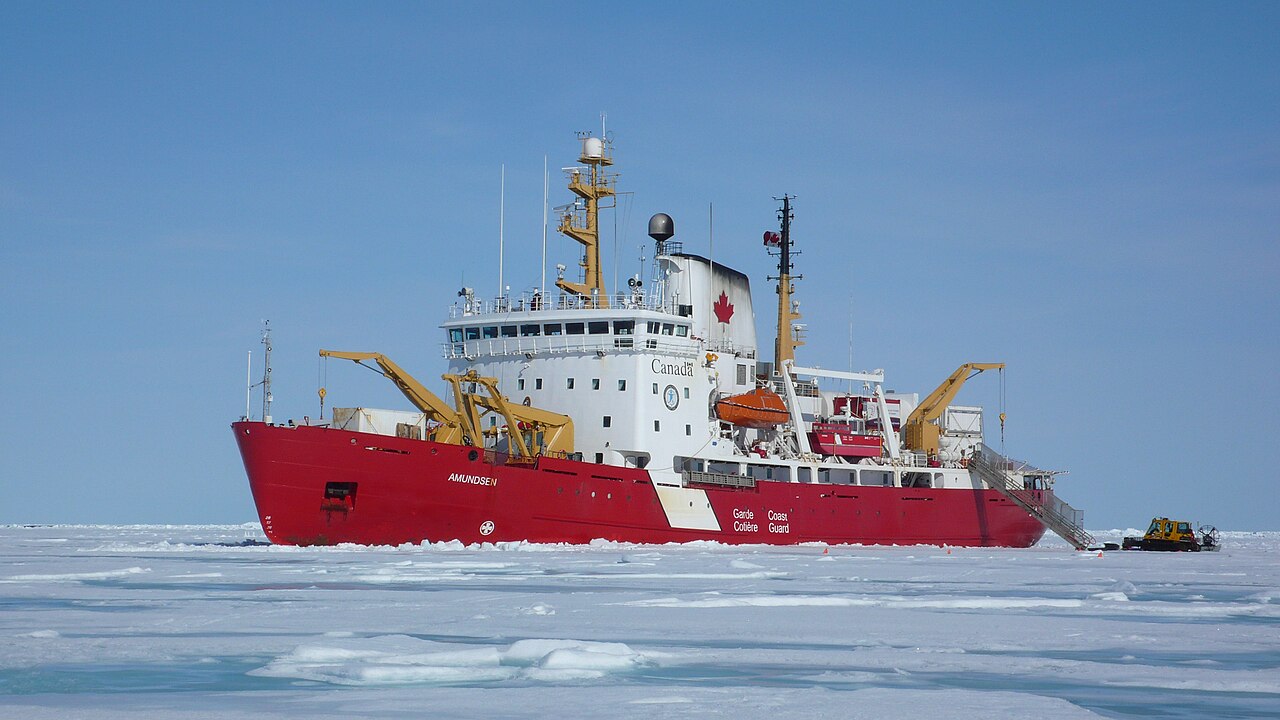
Current CCG Icebreaking Fleet
The Canadian Coast Guard (CCG) fleet includes 20 icebreaking vessels, from heavy icebreakers to hovercrafts.
|
Vessel |
Class |
|
CCGS Louis S. St-Laurent |
Heavy Icebreaker |
|
CCGS Terry Fox |
Heavy Icebreaker |
|
CCGS Amundsen |
Medium Icebreaker |
|
CCGS Captain Molly Kool |
Medium Icebreaker |
|
CCGS Des Groseilliers |
Medium Icebreaker |
|
CCGS Henry Larsen |
Medium Icebreaker |
|
CCGS Jean Goodwill |
Medium Icebreaker |
|
CCGS Pierre Radisson |
Medium Icebreaker |
|
CCGS Vincent Massey |
Medium Icebreaker |
|
CCGS Ann Harvey |
High Endurance Multi-Tasked Vessel |
|
CCGS George R. Pearkes |
High Endurance Multi-Tasked Vessel |
|
CCGS Griffon |
High Endurance Multi-Tasked Vessel |
|
CCGS Kopit Hopson 1752 |
High Endurance Multi-Tasked Vessel |
|
CCGS Martha L. Black |
High Endurance Multi-Tasked Vessel |
|
CCGS Sir Wilfrid Laurier |
High Endurance Multi-Tasked Vessel |
|
CCGS Sir William Alexander |
High Endurance Multi-Tasked Vessel |
|
CCGS Judy LaMarsh |
Medium Endurance Multi-Tasked Vessel |
|
CCGS Samuel Risley |
Medium Endurance Multi-Tasked Vessel |
|
CCGS Mamilossa |
Hovercraft |
|
CCGS Sipu Muin |
Hovercraft |
Classification
Canadian icebreakers have been classified under different systems. In 1970, the federal government passed the Arctic Waters Pollution Prevention Act. This included the Arctic Shipping Pollution Prevention Regulations (ASPPR), which governed navigation in Canadian coastal waters north of latitude 60˚N. The regulations include a Zone/Date System (Z/DS) that divides Canadian Arctic waters into 16 zones and specifies the opening and closing dates for different types of ships in these zones. The ASPPR established nine Arctic Classes for vessels, according to specific construction requirements and ice performance. For example, CCGS Louis S. St-Laurent, Canada’s heaviest icebreaker, was categorized Arctic Class 4. The ASPPR were replaced in 2017 by the Arctic Shipping Safety and Pollution Prevention Regulations (ASSPPR).
In 1996, the Department of Transport introduced the Arctic Ice Regime Shipping System (AIRSS), a more flexible system that recognizes the variability of ice conditions. The AIRSS allows ships to operate outside the zones and time periods specified by the Z/DS. Under this system, vessels are classified according to strength, displacement and icebreaking power. “Type” vessels (A to E) are designed to operate in first-year sea ice, while Canadian Arctic Class (CAC) vessels can operate in more severe ice conditions. A CAC 1 ship is designed for continuous operation in multi-year ice, while a CAC 4 vessel can operate in thick first-year ice.
|
CAC Vessel Class |
Maximum Allowable Ice Type |
Ice Thickness |
|
CAC 1 (AC 10) |
No limit |
No limit |
|
CAC 2 (AC 8) |
Multi-year ice |
No limit |
|
CAC 3 (AC 6) |
Second-year ice |
No limit |
|
CAC 4 (AC 3) |
Thick first-year ice |
Over 120 cm |
|
Type A |
Medium first-year ice |
70 to 120 cm |
|
Type B |
Thin first-year ice (stage 2) |
50 to 70 cm |
|
Type C |
Thin first-year ice (stage 1) |
30 to 50 cm |
|
Type D |
Grey-white ice |
15 to 30 cm |
|
Type E |
Open water / grey ice |
10 to 30 cm |
Polar Classes
Since 2008, icebreakers have been classified according to an international standard: the International Association of Classification Societies (IACS) Polar Classes. Most of Canada’s icebreaking fleet (as of October 2026) was built before the adoption of the IACS Polar Class system. For purposes of comparison, Canada’s heavy icebreakers such as CCGS Louis S. St-Laurent could be considered PC3 or PC4 vessels.
|
Polar Class |
Description |
Ice Thickness |
|
PC1 |
Year-round operation in all polar waters |
3.0 m or more |
|
PC2 |
Year-round operation in moderate multi-year ice |
Up to 3.0 m |
|
PC3 |
Year-round operation in second-year ice |
Up to 2.5 m |
|
PC4 |
Year-round operation in thick first-year ice |
Up to 2.0 m |
|
PC5 |
Year-round operation in medium first-year ice |
Up to 1.5 m |
|
PC6 |
Summer/autumn operation in medium first-year ice |
Up to 1.0 m |
|
PC7 |
Summer/autumn operation in thin first-year ice |
Up to 0.7 m |
Arctic and Offshore Patrol Vessels
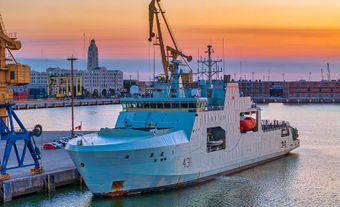
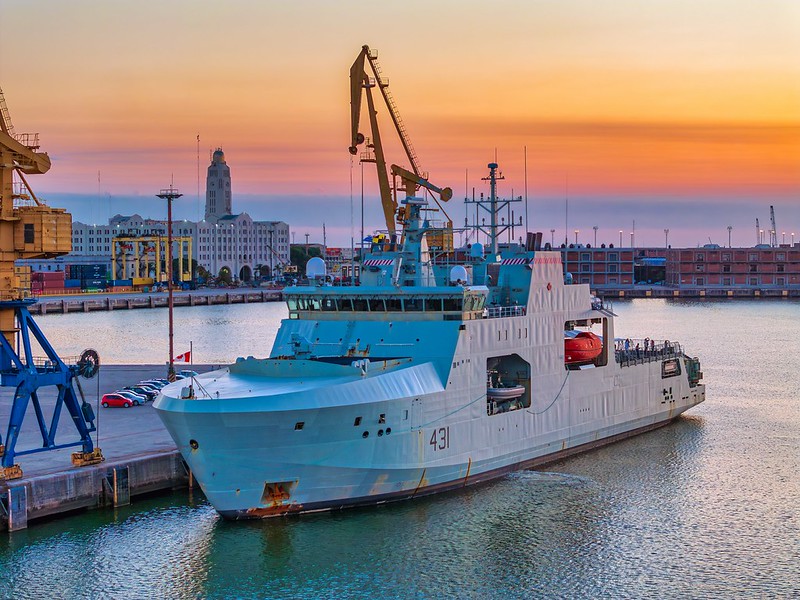
In 2007, the Canadian government announced that up to eight Polar Class 5 Arctic Offshore Patrol Ships would be acquired for the Royal Canadian Navy (RCN). The ships are intended to enhance surveillance and ensure sovereignty in northern waters. As of September 2026, six Harry DeWolf-class of Arctic and Offshore Vessels have been delivered to the RCN. Another two are being constructed for the CCG.
Future Icebreaking Fleet
Construction is underway to replace the CCG’s aging fleet of medium and heavy icebreakers. Two Polar Class 2 icebreakers are under construction for the CCG through the National Shipbuilding Strategy. The project was announced in 2008 but faced several delays; the ships are now forecast for delivery in the early 2030s. Seaspan’s Vancouver Shipyards is constructing the CCGS Imnaryuaq, with expected delivery in 2032. Chantier Davie Canada Inc. is building the second ship, CCGS Arpatuuq, with delivery expected in 2030. The hull of Arpatuuq is being built at the Canadian-owned Helsinki Shipyard in Finland, while the ship’s accommodations are under construction at its shipyard in Lévis, Quebec. Once complete, the Imnaryuaq and Arpatuuq will be among the most powerful icebreakers in the world.
In 2019, the federal government stated that it would also acquire six new program icebreakers under the National Shipbuilding Strategy. In August 2026, Prime Minister Mark Carney announced that Chantier Davie Canada Inc. will build six new Polar Class 3 icebreakers at its Lévis shipyard. Construction should begin in 2027, with expected delivery of the first ship in 2032. Completion of all six ships is forecast for 2038.
Did you know?
In 2024, Canada signed the ICE (Icebreaker Collaboration Effort) Pact, an agreement with NATO allies Finland and the US to develop and build world-class icebreakers together.
In 2026, Qikiqtaaluk Horizon Arctic Services (QHAS) announced that it was chartering MSV Nordica, a Polar Class 3 icebreaker, to operate in Canadian Arctic waters. QHAS is a joint venture of the Inuit Qikiqtaaluk Corporation and Horizon Naval Engineering of St. John’s, Newfoundland and Labrador. The Nordica, a Finnish government-owned vessel, will operate in coordination with the CCG. The ship arrived in Canadian waters in September 2026 and will provide additional heavy icebreaking capacity during the upcoming season. The Nordica is intended to support navigation and supply chains and strengthen the economy of Arctic and northern communities.