Share on Facebook
 Share on X
 Share by Email
 Share on Google Classroom
Sears Canada Inc. was a department store and specialty retailer based in Toronto, Ontario. Established in 1952 as a joint venture between Simpsons, Limited and Sears, Roebuck and Company, it operated as Simpsons-Sears until changing its corporate name in 1984. The company acquired T. Eaton Company in 1999. Sears Canada was liquidated and its final stores closed in January 2018.
Sears Canada Inc.
A Sears Canada Inc. store inside a mall in Toronto, Ontario, 22 June 2017.
(photo by Cole Burston/Bloomberg via Getty Images)
Beginnings
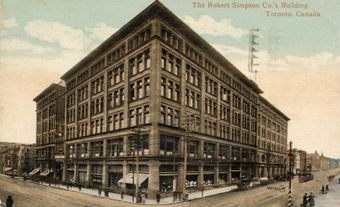
As the 1950s began, the catalogue and mail order business of Simpsons, Limited ranked second behind T. Eaton Company. Chicago-based Sears, Roebuck and Company — which was the sixth largest corporation in the United States — sought an established partner to enter the Canadian market. In July 1952, both companies announced that as of January 1953 a joint venture known as Simpsons-Sears Limited would purchase Simpsons’ Mail Order Agency and Order Office division. The enterprise would run a catalogue operation and open retail stores under the Simpsons-Sears branding.
Under the deal, both parent companies equally owned Simpson-Sears and were equally represented on its board of directors. No Simpsons-Sears locations would open within 25 miles of existing Simpsons stores, which affected Halifax, Nova Scotia, London, Ontario, Montreal, Quebec, Regina, Saskatchewan, and Toronto, Ontario. Existing Sears brands, like Craftsman and Kenmore, would be sold with certain brand products manufactured in Canada.
The first Simpsons-Sears catalogue was published in February 1953. It initially alienated its customers by following the American practice of charging them for shipping for hard goods and large items, a policy which was abandoned in 1956.
The company’s first retail store opened in Stratford, Ontario, in September 1953. Anticipated to be the first in a series of smaller stores specializing in furniture and appliances, it was unsuccessful and closed soon afterwards. Simpsons-Sears’ first full-size department store opened in Burnaby, British Columbia, in May 1954, where approximately 75,000 shoppers passed through during its opening day.
Separating from Simpsons
In 1971, Simpsons-Sears moved into a new headquarters, a concrete, inverted pyramid-shaped office building at 222 Jarvis Street in downtown Toronto.
Over time, the “Simpsons” name was deemphasized in the store logo and was reduced to “Sears” by the early 1970s. The 25-mile agreement was broken in 1973 with the opening of a Sears store at Square One Shopping Centre in Mississauga, Ontario. That year also saw the inauguration of a fully computerizing telephone ordering system for catalogue items.
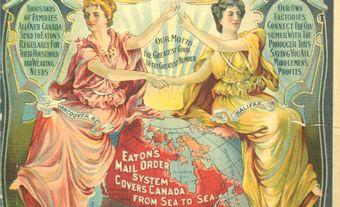
By 1976, the same year rival T. Eaton Company discontinued its catalogue, Simpsons-Sears had become the largest department store retailer in Canada, with $1.9 billion in sales and a 30 per cent market share.
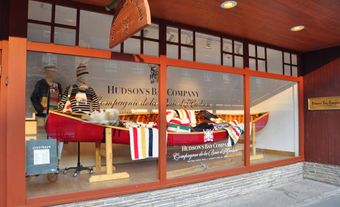
In September 1978, Simpsons, Limited and Simpsons-Sears announced a merger in principle, pending approval by the Foreign Investment Review Agency. Despite approval in December 1978, the merger fell through when the Hudson’s Bay Company (HBC) made a successful bid to purchase Simpsons and gained 35.7 per cent of Simpsons-Sears shares. The federal government ruled that Simpsons, Limited and Simpsons-Sears would operate separately and that all shared facilities and services must be severed, as well as having no common board members.
In 1983, Sears, Roebuck and Co. acquired HBC’s shares of Simpsons-Sears, and the company was renamed Sears Canada Inc. in May 1984.
In addition to continuing longstanding divisions such as Sears catalogue stores and Allstate Insurance, Sears Canada launched several new retail chains in the late 1990s, including Whole Home furniture stores, Sears Floor Covering Centres, and independent Sears Dealer Stores. It also launched its website, sears.ca.
Acquiring Eaton’s
In September 1999, Sears Canada acquired all shares and intellectual property of the bankrupt T. Eaton Company. As part of the sale, Sears agreed to lease eight Eaton’s stores, with the option to acquire leases of five others. Sears management believed that Eaton’s key stores would allow the company to tap into a different market segment of downtown higher-end consumers.
A new seven-store chain rebranded as eatons (with a small-case e) was launched in November 2000 with an advertising campaign spotlighting the colour aubergine. Retail analysts believed that budget overruns and a failure to live up to expectations led to the resignation of Sears Canada CEO Paul Walters in January 2001. His successor, Mark Cohen, announced in February 2002 that the eatons stores would close, with most converting into Sears locations.
Sears Holdings

In November 2004, Sears, Roebeck and Co. was purchased by Kmart Holding Corporation. The new company, which at the time owned 54 per cent of Sears Canada, was named Sears Holdings Corporation and was chaired by American hedge fund manager Edward Lampert. Among the most significant early moves Lampert made was to sell Sears Canada’s credit card business to J.P. Morgan Chase & Co. in 2005. That same year, Sears Holdings made a bid to make Sears Canada private, which reportedly took Canadian executives by surprise.
Sears Holdings failed in its initial attempt to make Sears Canada private in December 2005 due to a year-long battle with minority shareholders led by New York-based hedge fund manager Bill Ackman. To tighten control over Sears Canada, Lampert hired Dene Rogers as CEO in April 2006. As a cost-slashing move, Sears Canada’s corporate headquarters was sold in 2007, and its offices were moved above its store in the Toronto Eaton Centre.
Sears Holdings’ ownership level fluctuated in the early 2010s, as it bought out some minority shareholders, then reduced its overall share to try to spin the business off. There was a revolving door of CEOs, starting with former Loblaws executive Calvin McDonald (2011–13), who came to believe that Lampert and his board of directors were not truly committed to saving the company when they refused to fund turnaround plans.
After two short-terms executive chairman, Brandon Stranzl (2015–17) made another attempt to revive the chain, introducing a new store format in 2016 that resembled off-price discount retailers like TJX Companies (Marshalls and Winners). Technical mishaps due to a computer system replacement prior to the 2016 Christmas season was disastrous, as the kinks had not been worked out, leading to a lack of inventory visibility.
After announcing a major round of store closures and being delisted from the Toronto Stock Exchange, Sears Canada announced in October 2017 that it would liquidate its remaining 131 stores under various banners. Among the final department stores to close in January 2018 was the original full-size store in Burnaby, British Columbia.