Share on Facebook
 Share on X
 Share by Email
 Share on Google Classroom
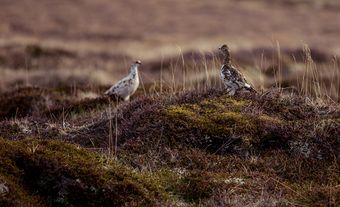
The grouse (Tetraonidae) is a small subfamily (18 species) of chickenlike birds with circumpolar distribution above latitude 26° north. It includes ptarmigans as well as those birds commonly called grouse. Members of the largest species can weigh up to 6,360 g; the smallest, 340 g. The sharp-tailed grouse is the provincial bird of Saskatchewan.

Taxonomy
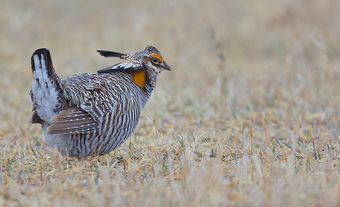
Of the 10 North American species, nine occur in Canada (six grouse, three ptarmigans). Grouse species are blue (Dendragapus obscurus), spruce (D. canadensis), ruffed (Bonasa umbellus), sharp-tailed (Tympanuchus phasianellus) and sage (Centrocercus urophasianus). The greater prairie-chicken (T. cupido) is extirpated in Canada. Grouse inhabit woodlands, tundra and, in North America, grasslands.
Description
Adult plumages are cryptic patterns of brown, grey and black with paler or white underparts. There are many plumage modifications associated with displays, e.g., pointed or curved tail feathers, elongated neck feathers, neck ruffs and pointed primaries. All species have completely or partially feathered legs; when toes are not feathered, they grow two rows of narrow scales, like the teeth of a comb, as "snowshoes." Nostrils are covered by feathers.
Reproduction
In breeding season, males give elaborate displays alone or in groups (leks) involving strutting, whirring of wings and sometimes vocal accompaniment. Some have red or yellow erectile combs above the eyes, and colourful neck patches of bare skin which are made prominent by the inflated esophagus.
Hunting
As a group, grouse are important game birds attracting over 10 million hunters annually. Ruffed grouse are the most sought-after species.
Status and Threats
While some grouse species are considered common, others have experienced significant declines primarily as a result of habitat loss and degradation (see Endangered animals). Two such Canadian species are the sage grouse (Centrocercus urophasianus) and the greater prairie chicken (Tympanuchus cupido pinnatus).
The greater prairie chicken was classified as endangered in Canada’s Species at Risk Act (SARA) in April 1978 (see Species at Risk Legislation in Canada). Despite this, the last sighting of the species in Canada occurred in 1987. Committee on the Status of Endangered Wildlife in Canada (COSEWIC) listed the species as extirpated in 1990, and SARA confirmed the listing in 2003.
Today, the sage grouse, which lives in southern Alberta and Saskatchewan, is classified as endangered by SARA. The primary causes of its decline are oil and gas wells, pipelines, industrial development (highways, buildings, fences, etc.) and the altering of hydrological systems (dams, dugouts, reservoirs, etc.). One subspecies of sage grouse has already been extirpated from Canada.